A Deep-Dive Into IFP-Components →
Read here

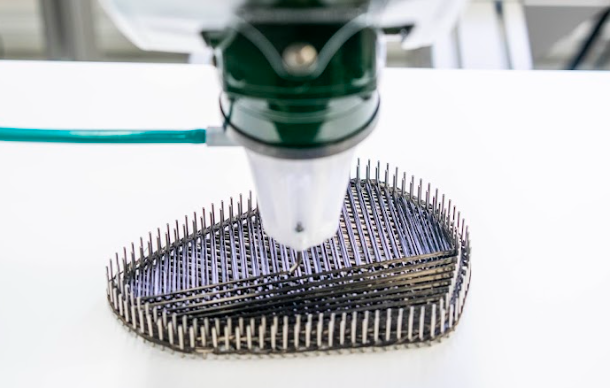
At Holy Technologies, we have redesigned the composite manufacturing process from the ground up. Designed for maximum efficiency, executed by robotics, and built for full circularity. Our system streamlines the entire composite value chain, from digital component design and fiber path optimization to scalable manufacturing and closed-loop remanufacturing. In this article, we explain how our end-to-end system turns digital designs into high-performance carbon fiber parts, enabling faster development, repeatable quality, and environmental responsibility.
Holy Technologies is a contract manufacturer of high-performance carbon fiber parts, supporting customers from component development through to series production. We work with manufacturers in industrial tools, robotics, medical devices, aerospace, and automotive. If you are new to carbon fiber: carbon fiber parts are often referred to as carbon fiber-reinforced polymer (CFRP) components or carbon fiber composites. These combine carbon fiber with a polymer matrix to create lightweight yet incredibly strong materials. Composites are engineered materials made by combining two or more distinct constituents to achieve properties not possible with a single material alone. Carbon fiber consists of tightly packed strands of carbon atoms, known as filaments, which are bundled into tows and aligned for maximum strength.
If this is the first time you read about composites, then we have a full explanation article for you here.
But manufacturing carbon fiber parts is often slow, manual, and wasteful, making composite production difficult to widely adopt and scale. Our technology changes that. At Holy Technologies, we are developing an end-to-end, autonomous composite production system that streamlines the entire development and manufacturing process of carbon fiber parts. It delivers repeatable performance at scale, speed, and built-in circularity. In this article, we explain how our system works, from digital design to finished part.
To learn more about our vision for a fully autonomous manufacturing system read this article.
Composite parts are usually made using a combination of six core elements:
Are these abbreviations new to you? Then this technology comparison article here might be right for you.
Each combination, or system, impacts part performance, production speed, scalability, and recyclability. Most systems require trade-offs between weight and strength, sustainability and performance, or automation and design freedom. This holds back innovation and the adoption of this high-potential material. Holy Technologies built a system that eliminates such trade-offs, making it easier and faster for companies to innovate with carbon fiber composites.

At Holy Technologies, the name reflects the philosophy: we approach composite manufacturing as an integrated whole, rethinking every step from design to recycling rather than optimizing in isolation. Our system tightly integrates software, hardware, and materials and is built on the following core choices:
This combination gives us complete control over part performance, speed, and recyclability; all in a scalable, highly efficient process. Let us dive into our technology and explore how we built a system for next-generation composite manufacturing.
We combine two foundational digital tools: advanced simulation and intelligent fiber orientation to create innovative parts. While they work hand-in-hand, each serves a distinct purpose and offers unique advantages.
A. Advanced Component Simulation
We start each project in software. Using our simulation stack, we analyze the part’s geometry, the expected loads it must handle, and its functional use case. This allows us to pinpoint exactly where reinforcement is needed and, just as importantly, where we can reduce material without sacrificing performance. This approach prevents overbuilding, reduces weight, and optimizes fiber usage before a single strand is placed.


B. Intelligent Fiber Orientation
Once we understand what the part needs, we calculate the optimal fiber orientation to meet those demands. Instead of laying down large plies, we work at the fiber level: each strand follows a digitally calculated path, precisely aligned to zones of tension, compression, or flex. We control not just the placement, but the direction, density, and continuity of each fiber, producing high-performance components.


Together, these capabilities allow us to:
Once the design is finalized, we move to physical execution using our robotic fiber placement system.
In collaboration with Visa Cash App RB, this approach enabled a 20% weight reduction while maintaining full part performance.
Once the digital design is finalized, our patented IFP (Infinite Fiber Placement) system brings it to life. Using continuous dry fiber, our robotic process lays fibers directly onto the mold surface, following freeform paths with high precision. Unlike other systems, IFP can follow complex contours, adapt reinforcement width, and steer around integrated features, all without additional tools or manual intervention. It is able to cope with flat or single-curved surface geometries. After layup, the component is infused with a recyclable epoxy resin via RTM. This closed-mold process creates a cured, high-strength part with no trimming or drilling required.
This allows us to:
To understand exactly which part geometries, sizes, and industries IFP is optimized for, read our deep dive into IFP components.

At Holy Technologies, we do not treat recyclability as an afterthought, it is built into our design, materials, and process architecture from the start. Most composite recycling methods result in heavy downcycling: fibers are chopped or burned, and the result is a lower-grade filler rather than a usable material. Our approach changes that. We design every component to be 100% recyclable, both in concept and execution. Our materials and process make it possible to extract and reuse continuous fiber with high property retention, while safely reclaiming the resin by dissolving it with mild chemistry.
We achieve this by:
These design choices make it possible to recover both fiber and resin in a reusable state. Independent tests with TU Hamburg and Teijin Carbon show that after two full recycling cycles, fibers retained 97% on average per cycle of their original mechanical performance. These results validate that real circularity is possible, not only in theory, but in practice, across multiple lifecycles.
For a deep dive into how our recycling process works, read our full article on the circularity of our components.
While a part may be 100% recyclable in design, the performance of the recovered material may not be identical to virgin material.

Our system is especially suited for parts where strength, weight, and performance matter, and where time-to-market or design flexibility is critical.
If your industry is not listed here, that is not a problem. We focus on load-bearing components for mid- to high-volume production. If you have a component that meets the criteria discussed above, we can likely help. Our system supports production batch sizes from 50 to 200,000+ parts, with repeatable quality.
Holy Technologies offers a fully integrated approach to producing high-performance carbon fiber composite components, designed for speed, scalability, performance, and real circularity. By combining advanced simulation, intelligent fiber orientation, robotic fiber placement, and closed-loop circularity, we simplify innovation with composites and raise the bar for what is possible. If you are looking to reduce weight, accelerate development, scale your composites, or improve circularity in your product line, we can help you go from digital design to ready-to-use composite parts in a number of weeks, and close the loop at end of life.
If you are looking to reduce weight, accelerate development, scale your composites, or improve circularity in your product line, we can help you go from digital design to ready-to-use composite parts in a number of weeks, and close the loop at end of life.
.svg)